
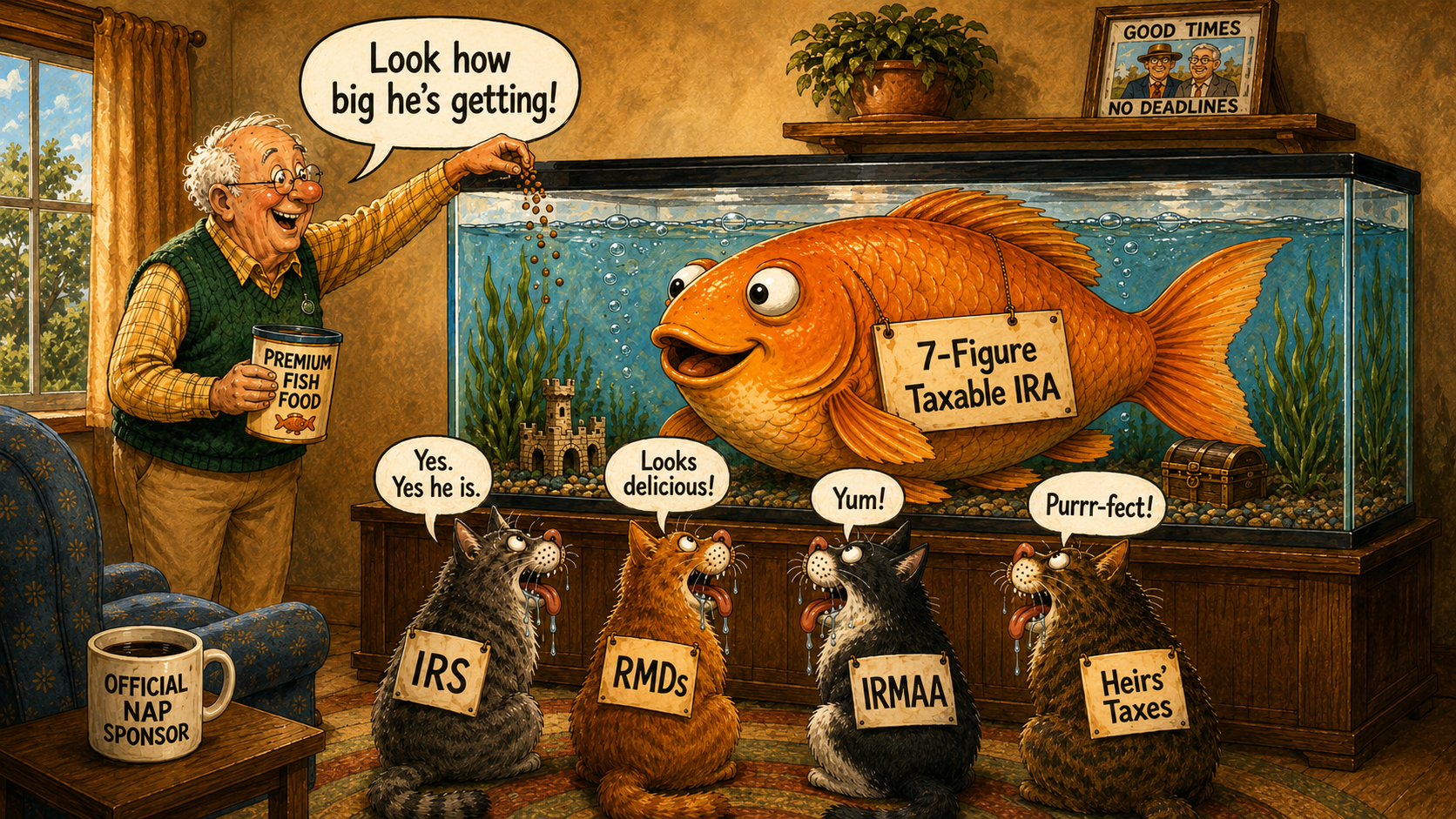
Building a large IRA is often seen as a sign of successful retirement planning. Reaching $1 million or more in a traditional IRA or 401(k) usually represents years of disciplined saving, investing, and taking advantage of tax-deferred growth.
However, a large retirement account can also create significant tax challenges later in life.
The key issue is that tax-deferred does not mean tax-free. Traditional IRA and 401(k) withdrawals are generally taxable as ordinary income, and the larger these accounts become, the more important retirement tax planning may become.
Here are several tax problems with a large IRA that retirement savers should understand.
How a Seven-Figure IRA Can Continue Growing
Consider a hypothetical 50-year-old with $1 million invested in a traditional IRA.
If the account earned an average return of approximately 10% annually, the Rule of 72 suggests the balance could roughly double every seven years.
That could result in approximately:
- $2 million around age 57
- $4 million around age 64
- $8 million around age 71
This is only a hypothetical illustration. Investment returns are not guaranteed, and actual market performance can vary significantly.
The example does highlight an important retirement tax-planning issue: a large tax-deferred account today could become a much larger taxable account in the future.
Required Minimum Distributions Can Increase Retirement Taxes
One of the primary tax problems with a large IRA involves Required Minimum Distributions, or RMDs.
Traditional IRAs and many employer-sponsored retirement plans eventually require account owners to begin taking distributions.
Under current federal law, people born in 1960 or later generally begin RMDs at age 75.
RMD amounts are calculated using the retirement-account balance and IRS life-expectancy factors. As an IRA balance grows, required distributions can also become significant.
These withdrawals generally count as taxable income.
When RMDs are combined with Social Security, pensions, rental income, investment income, or other retirement income, retirees may find themselves in a higher tax bracket than expected.
Retirement Does Not Guarantee a Lower Tax Bracket
Many people assume their taxes will automatically fall after they stop working.
That may not happen.
Someone with a multimillion-dollar traditional IRA may still generate substantial taxable income through RMDs and other retirement-income sources.
Future tax rates are also uncertain. Federal tax laws and tax brackets can change over time.
This is why retirement tax planning should consider not only how much money is accumulated, but also where that money is held from a tax perspective.
A household with assets spread across traditional, Roth, and taxable accounts may have more flexibility than one with most retirement wealth concentrated in tax-deferred accounts.
Surviving Spouses Can Face Higher Tax Rates
Another overlooked issue involves married couples.
While both spouses are alive, they may file taxes as Married Filing Jointly. After one spouse dies, the surviving spouse may eventually file as a single taxpayer.
Single-filer tax brackets generally have lower income thresholds.
However, the surviving spouse may still own most of the couple’s retirement assets and continue receiving RMDs, Social Security, rental income, and investment income.
This means similar income could potentially be taxed at higher marginal rates.
This situation is often referred to as the widow’s or widower’s tax penalty.
Inherited IRA Taxes Can Affect the Next Generation
Large retirement accounts can also create tax challenges for beneficiaries.
Under current inherited IRA rules, many non-spouse beneficiaries generally must fully distribute an inherited retirement account within 10 years.
This can be especially important when adult children inherit retirement assets during their peak earning years.
For example, a child in their 40s or 50s may already have significant salary or business income. Adding taxable inherited IRA distributions could push part of their income into higher tax brackets.
For families with substantial retirement assets, inherited IRA taxation should therefore be considered alongside broader estate and legacy planning.
Roth Conversion Planning May Help Manage Future Taxes
One strategy often evaluated for large traditional IRAs is a Roth conversion.
A Roth conversion transfers assets from a traditional retirement account into a Roth IRA. Taxes are generally paid on the converted amount in the year of conversion.
Qualified Roth IRA withdrawals can then be tax-free.
However, Roth conversion planning is not simply about converting as much as possible.
The timing and size of conversions matter because additional taxable income may affect income-tax brackets, Medicare IRMAA surcharges, and other financial considerations.
For some retirees, lower-income years between retirement and the beginning of RMDs may create opportunities to evaluate conversions.
Why Large IRA Tax Planning Matters
A seven-figure IRA can create significant financial security, but it can also create greater tax complexity.
Retirement planning for high-balance accounts should consider RMDs, future tax brackets, Roth conversions, Medicare premiums, surviving-spouse taxation, inherited IRA rules, and estate planning.
The larger the account becomes, the more important it may be to think beyond accumulation.
A complete retirement strategy considers not only how much wealth is being built, but also how that wealth may eventually be taxed, withdrawn, and transferred to the next generation.